The Skincare Order Mistake Almost Everyone Makes
Why the sequence of your products matters more than you think.
Most people spend a lot of time choosing skincare products. They research ingredients, read reviews, and sometimes build routines with five or six different steps. Serums, toners, moisturizers, and sunscreens all promise to improve the skin in different ways.
But there is one detail that surprisingly many people overlook. The order of skincare. Even the best skincare products cannot perform properly if they are applied in the wrong sequence.
Certain ingredients are designed to penetrate the skin deeply, while others are meant to sit on the surface and protect the skin barrier. When these products are layered incorrectly, the skin may not absorb them the way they were intended.
Dermatologists who study skin health in fields like Dermatology often explain that skincare layering works much like chemistry. The texture and molecular size of products determine how easily they move through the skin.
That is why skincare professionals and beauty editors at publications like Allure and Vogue frequently emphasize one simple rule: Apply skincare from the lightest texture to the heaviest. Understanding this principle can quietly transform how well your skincare routine works.
Why Skincare Order Matters
Skin is not an open sponge that absorbs anything placed on it. Instead, it has a protective outer layer known as the skin barrier, which controls what enters and leaves the skin.
This barrier is extremely effective at keeping unwanted substances out. That is great for protection, but it also means skincare products must be formulated carefully to penetrate the skin properly.
Lightweight products like toners and serums contain smaller molecules designed to absorb quickly. Thicker products like creams and oils create a protective seal that locks moisture into the skin.
Applying heavy cream before a serum can prevent the serum from reaching the skin because the cream creates a barrier on the surface. That is why the order of application can influence whether your skincare actually reaches the layers where it needs to work.

The Ideal Skincare Order
Although skincare routines can vary by individual needs, the overall structure remains fairly consistent. The goal is to shift from products that clean and prepare the skin to products that treat and protect it.
A typical skincare order looks like this:
- Cleanser
- Toner or essence
- Treatment serums
- Eye cream
- Moisturizer
- Sunscreen (in the morning)
Each step prepares the skin for the next one.
Step 1: Cleanser
Every skincare routine begins with cleansing. Throughout the day, the skin collects oil, sweat, sunscreen, pollution, and makeup residue. Cleansing removes impurities, allowing treatment products to reach the skin more effectively.
Without proper cleansing, skincare products may sit on top of buildup rather than penetrate the skin.
In the evening, many skincare enthusiasts use double cleansing, starting with an oil-based cleanser to dissolve makeup and sunscreen, followed by a gentle water-based cleanser to remove remaining impurities. This two-step approach ensures the skin is fully clean without excessive scrubbing.
Step 2: Toner or Essence
After cleansing, the skin is slightly more receptive to hydration. Toners and essences are typically lightweight liquids designed to restore moisture and prepare the skin for treatment products.
Many modern toners contain hydrating ingredients like glycerin or hyaluronic acid, which help attract water to the skin.
Because these formulas are thin and watery, they absorb quickly, creating a smooth surface for serums to follow. Skipping toner is not necessarily harmful, but when used correctly it can help improve how later products absorb.
Step 3: Treatment Serums
Serums are usually the most concentrated part of a skincare routine. They contain targeted ingredients designed to address specific concerns such as dullness, uneven tone, or dehydration.
For example, vitamin C serums are often formulated to brighten the complexion, while niacinamide serums help balance sebum production and support the skin barrier.
Because serums are formulated with smaller molecules, they penetrate deeper into the skin than thicker creams. This is why they should be applied early in the routine before heavier products.
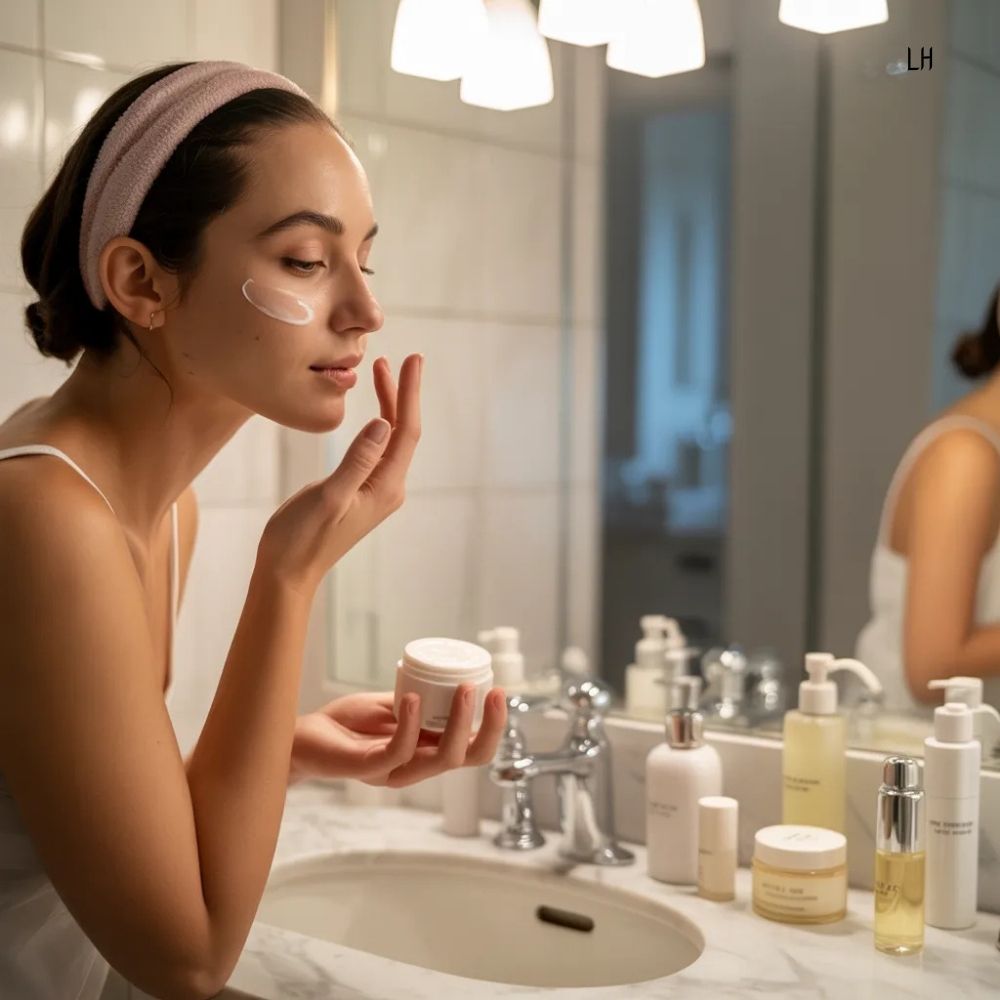
Step 4: Eye Cream
The skin around the eyes is thinner and more delicate than the rest of the face. Eye creams are designed to hydrate this area and address concerns like dryness, puffiness, or dark circles.
Applying eye cream before moisturizer allows it to absorb properly without being diluted by heavier products. Most people only need a very small amount. A gentle tap using the ring finger is usually enough to distribute the product evenly.
Step 5: Moisturizer
Moisturizer is one of the most important steps in skincare because it helps strengthen the skin barrier. A good moisturizer locks in hydration while preventing moisture loss during the day or night.
Even people with oily skin benefit from moisturizers because dehydration can actually trigger the skin to produce more oil. By sealing in previous skincare layers, a moisturizer helps ensure that earlier-applied ingredients remain effective longer.
Step 6: Sunscreen
In the morning, sunscreen should always be the final step of a skincare routine. Sunscreen protects the skin from ultraviolet radiation, which is one of the main contributors to premature aging and skin damage.
Because sunscreen forms a protective layer on the skin’s surface, it must be applied after other skincare products. Applying sunscreen earlier in the routine could prevent treatment products from reaching the skin effectively.
Dermatologists consistently emphasize sunscreen as one of the most important daily skincare habits for maintaining healthy skin over time.
Common Skincare Order Mistakes
Many skincare routines become less effective because of simple layering mistakes. One common error is applying facial oils before serums. Oils create a barrier that can block lightweight serums from absorbing properly.
Another mistake is applying sunscreen too early in the routine rather than as the final step.
Some people also apply too many treatment products at once without allowing each layer to absorb. This can cause products to mix rather than work independently. Giving each layer a few seconds to settle helps prevent this problem.
Why Simple Routines Often Work Best
One interesting truth about skincare is that more products do not always produce better results. Sometimes the most effective routines are the simplest ones. Cleanser, serum, moisturizer, and sunscreen can already address many common skincare needs.
Adding too many products can increase the risk of irritation or conflicting ingredients. The goal of skincare is not complexity. It is consistency and balance.
The Small Detail That Changes Everything
Many people spend years searching for the perfect skincare products. But sometimes the biggest improvement comes from something much simpler. Applying those products in the correct order allows each to perform its intended function.
When lightweight treatments reach the skin before heavier creams seal everything in, the entire routine becomes more effective. And that small change can quietly transform how your skincare works over time.